
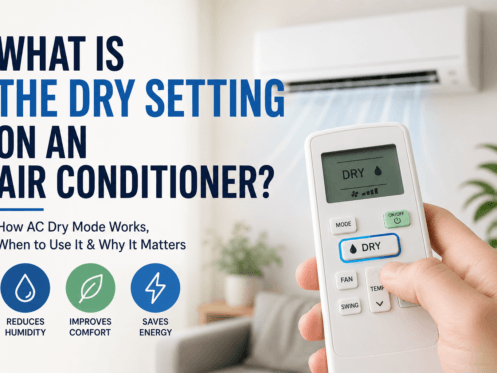
The dry setting on an air conditioner removes excess moisture from the air while using less cooling power than standard cool mode. It helps improve comfort during humid weather by lowering indoor humidity levels without dramatically lowering the room temperature.
Dry mode works best on warm, muggy days when the air feels damp but the room doesn’t necessarily need heavy cooling.
What Does Dry Mode Do on AC?
Air conditioner dry mode is primarily focused on humidity control.
Instead of running continuously to cool the room, the system cycles the compressor on and off at lower speeds while the indoor fan runs more gently. This process pulls moisture from the air and drains it away through the condensate system.
The result is air that feels drier, lighter, and more comfortable.
Many homeowners are surprised by how much humidity affects comfort. A room at 74°F with high humidity can feel warmer and stickier than a room at 78°F with balanced humidity.
That’s why dry mode can make a home feel cooler even when the actual temperature barely changes.
How Does AC Dry Mode Work?
Your air conditioner naturally removes some humidity whenever it cools. Dry mode simply prioritizes moisture removal over temperature reduction.
Here’s what typically happens in air conditioner dry mode:
- The compressor turns on for short intervals
- The indoor fan runs at a slower speed
- Moisture condenses on the evaporator coil
- Water drains outside through the condensate line
- The system maintains mild cooling while focusing on dehumidification
Think of it like a “light dehumidifier mode” built into your AC system.
Most mini-split systems and many modern central air systems include this feature.
Dry Mode vs Cool Mode
One of the biggest homeowner questions is the difference between dry mode vs cool mode.
Cool Mode
Cool mode is designed to lower the room temperature quickly and maintain a specific thermostat setting.
In cool mode:
- The compressor runs longer
- The fan speed is usually higher
- The system prioritizes temperature reduction
- Humidity removal happens as a secondary effect
Dry Mode
Dry mode is designed to remove moisture from the air with gentler cooling.
In dry mode:
- The compressor cycles more slowly
- The fan operates at lower speed
- The system prioritizes humidity reduction
- Temperature changes are minimal
A good rule of thumb:
- Use cool mode when the house is hot
- Use dry mode when the house feels damp or muggy
When to Use Dry Mode
Knowing when to use dry mode helps homeowners stay comfortable while avoiding unnecessary energy use.
Dry mode works best during:
- Mildly warm but humid days
- Rainy weather
- Spring and early summer humidity
- Overnight humidity spikes
- Coastal or subtropical climates
For example, imagine it’s 76°F outside after an afternoon thunderstorm. Your home feels clammy, but blasting cold air would make the room too chilly. That’s an ideal time to switch to AC dry mode.
Homeowners in humid regions often use dry mode during:
- Early mornings
- Evenings
- Rainy stretches
- Shoulder seasons when temperatures fluctuate
Does Dry Mode Save Electricity?
In many situations, yes.
One of the advantages of air conditioner dry mode is lower energy usage compared to full cooling mode.
Because the compressor runs less aggressively, the system typically consumes less electricity while still improving comfort.
That said, savings depend on:
- Outdoor humidity levels
- Indoor temperature
- AC system efficiency
- Home insulation
- How long the mode runs
If the room is already hot, dry mode may not be effective enough, causing the system to run longer without delivering real comfort.
In those cases, cool mode is usually more efficient overall.
Does Dry Mode Actually Cool the Room?
Yes — but only slightly.
Many homeowners expect dry mode to function like regular air conditioning, but that’s not its primary job.
As moisture leaves the air, the room often feels cooler because lower humidity improves the body’s natural ability to release heat through evaporation.
This is why:
- 78°F with low humidity can feel comfortable
- 72°F with high humidity can feel sticky and uncomfortable
Dry mode improves “felt comfort” more than actual temperature reduction.
When NOT to Use Dry Mode
Dry mode isn’t ideal in every situation.
You should avoid using it:
- During extremely hot weather
- When indoor temperatures are already too high
- In very dry climates
- During heat waves
- If the room needs rapid cooling
For example, if it’s 95°F outside and your home is struggling to stay cool, dry mode won’t provide enough cooling power.
Running it too long in already dry conditions can also make indoor air feel overly dry, leading to:
- Dry throat
- Static electricity
- Skin irritation
Pros and Cons of AC Dry Mode
Pros
- Reduces indoor humidity
- Improves comfort in muggy weather
- Uses less energy in certain conditions
- Helps prevent damp, sticky indoor air
- Can reduce mold-friendly moisture levels
Cons
- Doesn’t cool aggressively
- Less effective during extreme heat
- Can over-dry air if overused
- Not ideal for very dry climates
Final Thoughts
The dry setting on an air conditioner is one of the most useful features for improving indoor comfort during humid weather. By removing excess moisture from the air, AC dry mode helps your home feel cooler, fresher, and less sticky without relying on heavy cooling.
If your home constantly feels humid, clammy, or uncomfortable, it may also be worth having your HVAC system inspected to ensure it’s properly sized and operating efficiently. A well-maintained air conditioner should control both temperature and humidity effectively.