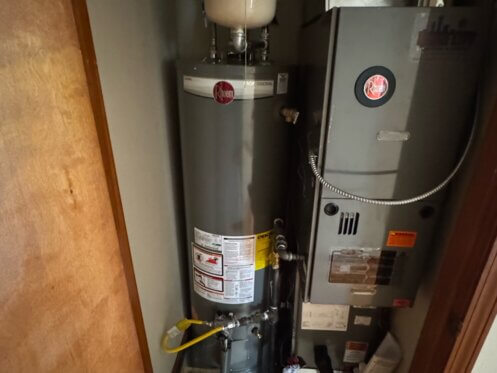
Yes, a gas furnace uses electricity even though natural gas produces the heat. Electricity powers the thermostat, ignition system, control board, safety switches, inducer motor, and blower that circulates warm air through your home.
Without electricity, most modern gas furnaces cannot ignite, verify safe operation, or distribute heat. This means a typical gas furnace will stop working during a power outage, even when the home still has natural gas service.
Understanding how your furnace uses both energy sources can help you estimate operating costs, prepare for winter outages, and recognize electrical problems that may require professional attention.
Why Does a Gas Furnace Need Electricity?
Natural gas provides the fuel, but electricity operates nearly every part responsible for starting and controlling the heating cycle.
When your thermostat detects that the house is colder than the selected temperature, it sends an electrical signal to the furnace; the inducer motor starts, creating the airflow required for safe combustion. The pressure switch confirms that exhaust gases can leave the home properly, and the electronic igniter lights the burners.
Once the heat exchanger becomes warm enough, the blower motor begins moving air across it. That heated air travels through the ductwork and into the rooms of your home. The control board monitors the entire process and shuts the furnace down if it detects an unsafe condition.
The main electrical components include:
- Thermostat and low-voltage transformer
- Electronic igniter
- Furnace control board
- Draft inducer motor
- Blower motor
- Flame sensor and safety switches
- Electronic gas valve
- Condensate pump, when one is installed
This combination of natural gas and electricity is why a gas furnace is not considered a completely non-electric heating system. The U.S. Department of Energy notes that conventional gas furnaces require grid electricity for their fans, igniters, and controls.
Does a Gas Furnace Use Electricity in the Winter?
A gas furnace uses electricity whenever it operates, including throughout the winter. However, it does not draw its maximum electrical load continuously.
The furnace uses a small amount of standby electricity while waiting for the thermostat to request heat. When a heating cycle begins, the igniter, inducer motor, and control system operate first. The circulating blower then becomes the largest electrical load during most of the cycle.
How much electricity the furnace consumes over an entire winter depends on:
- How many hours the blower operates
- The efficiency and condition of the blower motor
- The furnace size and heating stages
- Thermostat settings
- Outdoor temperatures
- The home’s insulation and air leakage
- Airflow restrictions caused by dirty filters or duct problems
During a cold spell in Nixa, a furnace may run substantially longer than it does during mild weather. A system with an efficient variable-speed ECM blower will generally use less electricity than an older furnace equipped with a traditional PSC motor.
Running the fan continuously from the thermostat can also increase electrical consumption. Although continuous circulation may improve air mixing or filtration, the cost depends heavily on the type and speed of the blower motor.
How Many Amps Does a Gas Furnace Use?
A typical residential gas furnace may draw approximately 3 to 8 amps while operating, although the actual amperage can fall outside that range. The blower motor accounts for most of the electrical demand.
Many gas furnaces operate on a dedicated 120-volt, 15-amp circuit. Larger systems or units with additional accessories may require a 20-amp circuit. The circuit rating is not the same as the furnace’s normal electrical draw. A furnace connected to a 15-amp circuit does not necessarily consume 15 amps continuously.
For example, a furnace drawing 5 amps at 120 volts has an approximate electrical demand of:
120 volts × 5 amps = 600 watts
If it operated at that load for one full hour, it would consume approximately 0.6 kilowatt-hours of electricity.
Motors can briefly draw additional current when starting. This starting surge is one reason a generator must be sized for more than the furnace’s ordinary running load.
The correct amperage for a particular furnace should be verified on its rating plate, installation manual, or electrical circuit. A technician may also measure the operating current with the proper test equipment. Homeowners should not remove electrical panels or reach into an operating furnace to take this measurement.
An unexpectedly high electrical draw could indicate a struggling blower motor, dirty blower wheel, incorrect motor speed, low voltage, or restricted airflow. If the furnace repeatedly trips its breaker, do not replace the breaker with a larger one. Turn the system off and arrange for furnace repair in Nixa, MO.
How Much Electricity Does a Gas Furnace Use?
A gas furnace’s electrical consumption varies considerably by model and operating conditions. As a simple illustration, a furnace drawing 400 to 800 watts while heating would use 0.4 to 0.8 kilowatt-hours if it ran continuously for one hour.
Missouri’s average residential electricity price was 13.45 cents per kilowatt-hour for the year-to-date through June 2026, according to the U.S. Energy Information Administration. At that rate, 0.4 to 0.8 kilowatt-hours would cost approximately 5 to 11 cents per operating hour.
That is only the estimated electricity used by the furnace. Natural gas normally represents the larger portion of the hourly heating cost.
A furnace also cycles rather than operating continuously under normal conditions. Therefore, one clock hour with the thermostat on is not necessarily one full hour of fuel and electrical consumption.
Does a Gas Furnace Work When the Power Is Out?
A standard modern gas furnace normally will not work during a power outage. The burners may use natural gas, but the furnace still needs electricity to run its ignition system, control board, inducer fan, safety devices, and circulating blower.
The system is designed to shut down when electrical power disappears. This prevents the furnace from attempting to burn fuel without the equipment needed to manage combustion and distribute heat safely.
Some older gas heaters used standing pilot lights and natural convection instead of electric blowers. Those appliances may operate differently, but a modern forced-air gas furnace should be expected to stop when the power goes out.
When electricity is restored, many furnaces resume normal operation automatically. Check the thermostat and furnace breaker if the heat does not return. If the furnace attempts to start but shuts down, avoid repeatedly resetting the system. A safety control may be preventing operation for a legitimate reason.
Can You Run a Gas Furnace With a Generator?
A properly sized portable or standby generator may operate a gas furnace, but the connection must be safe and code-compliant. Furnace motors can have a higher starting demand than their normal running wattage, so generator sizing should account for both running watts and startup surge.
The furnace also needs suitable voltage, frequency, and grounding. Some modern control boards and flame-sensing systems may not operate correctly with unstable power or an improperly configured generator.
Never connect a generator to a home by plugging it into a wall outlet. This dangerous practice can energize utility lines, create a fire hazard, and expose utility workers to potentially fatal backfeed. Portable generators must also remain outdoors and well away from doors, windows, and air intakes because they produce carbon monoxide.
A licensed electrician should install an approved transfer switch or other code-compliant connection method. Before depending on a generator for emergency heat, have both the electrical setup and furnace requirements evaluated.
How Much Does It Cost to Run Gas Heating for One Hour?
A typical residential gas furnace may cost approximately $0.70 to $1.50 per hour of continuous burner operation, including a modest amount of electricity. The actual amount depends on the furnace’s input rating, gas price, blower consumption, and whether the burners operate at full or reduced capacity.
The hourly gas cost can be estimated with this formula:
Furnace input in BTUs ÷ 100,000 × natural-gas price per therm
Suppose a furnace has an input rating of 80,000 BTUs per hour and natural gas costs $1.40 per therm:
80,000 ÷ 100,000 × $1.40 = $1.12 per hour
If the furnace consumes approximately 600 watts of electricity, its electrical cost at 13.45 cents per kilowatt-hour would be about 8 cents per hour. The combined operating cost would therefore be approximately $1.20 for one hour of continuous operation.
For comparison, estimated costs at $1.40 per therm would look like this:
| Furnace input | Estimated gas cost per operating hour |
|---|---|
| 40,000 BTUs | $0.56 |
| 60,000 BTUs | $0.84 |
| 80,000 BTUs | $1.12 |
| 100,000 BTUs | $1.40 |
These figures represent burner input, not the amount of useful heat delivered to the house. Furnace efficiency determines how much of that fuel becomes usable heat. An 80% AFUE furnace converts approximately 80% of its seasonal fuel input into heat for the home, while a 96% AFUE furnace converts approximately 96%.
The calculation also excludes fixed utility charges, taxes, and other items that may appear on a bill.
The EIA reported Missouri’s average residential natural-gas price at $14.24 per thousand cubic feet in February 2026, although household rates vary by provider, month, and billing plan.
Why Your Actual Heating Cost May Be Different
An 80,000-BTU furnace does not necessarily consume 80,000 BTUs during every clock hour of winter. That rating generally describes its fuel input while the burners are operating. The furnace turns off after the thermostat reaches its target temperature and starts again when the house needs more heat.
A two-stage furnace may spend much of its time operating at a lower firing rate. A modulating furnace can make smaller adjustments based on heating demand. These systems may run for longer cycles while consuming less gas per minute than they would at full capacity.
The condition of the house matters as much as the furnace itself. Poor insulation, duct leakage, air infiltration, and an unnecessarily high thermostat setting can keep even an efficient furnace running longer.
A dirty filter can restrict airflow and cause the furnace to overheat. When that happens, the high-limit switch may shut the burners off while the blower continues running. This wastes energy, reduces comfort, and places unnecessary stress on the equipment.
How to Reduce Gas-Furnace Operating Costs
Begin with a clean furnace filter and replace it according to its condition rather than relying solely on a fixed calendar. Homes with pets, renovation dust, or heavy furnace use may need more frequent filter changes.
Keep supply registers and return grilles open and unobstructed. Closing multiple vents does not reliably save energy and may create excessive static pressure in the duct system.
Use moderate thermostat setbacks rather than turning the temperature dramatically up and down. A smart or programmable thermostat can reduce unnecessary heating when the house is empty without sacrificing comfort when the family returns.
Annual furnace maintenance is also important. A technician can inspect the burners, heat exchanger, flame sensor, blower assembly, electrical connections, and safety controls. Maintenance will not overcome poor insulation or an improperly sized furnace, but it can help the equipment operate safely and as intended.
If your furnace runs almost constantly, produces uneven temperatures, or causes unusually high utility bills, the system may have an airflow, duct, sizing, or mechanical problem. Queen City Heating & Cooling provides professional heating and air-conditioning service in Nixa, MO, for homeowners who need their system inspected.
When Electrical Use May Indicate a Furnace Problem
Call an HVAC professional if the furnace trips its breaker, produces a burning electrical smell, hums without starting, or experiences repeated blower problems. These symptoms may point to a failing motor, damaged capacitor, loose wiring, overloaded circuit or control-board problem.
Turn the furnace off immediately if you see sparks, notice melted wiring, or smell burning plastic. Electrical furnace repairs should not be treated as a do-it-yourself project.
Problems that appear electrical can also originate elsewhere. For example, a restricted filter may increase strain on the blower, while an overheating furnace may repeatedly interrupt the heating cycle through a safety switch. Proper diagnosis should consider the complete system rather than replacing a component based on one symptom.
Frequently Asked Questions
Does a gas furnace use both gas and electricity?
Yes. Natural gas creates heat at the burners, while electricity operates the controls, ignition system, inducer motor, blower and safety devices.
Will the gas still flow to my furnace during a power outage?
Natural gas service may remain available, but the furnace’s gas valve and safety controls generally prevent the burners from operating without electricity. The furnace is designed to shut down when it cannot safely complete its operating sequence.
How many watts does a gas furnace use?
Many furnaces may draw roughly 400 to 800 watts while operating, but actual consumption varies considerably. Efficient ECM blowers may use less under certain conditions, while larger or older motors may use more. Consult the furnace data plate or have the operating load measured.
Is a gas furnace cheaper to run than electric heat?
Gas furnaces are often less expensive to operate than electric resistance heating, but the comparison depends on local utility prices, equipment efficiency, climate, and the condition of the home. A high-efficiency heat pump may produce a different result than electric resistance heaters.
Why does my electric bill increase when I use gas heat?
The furnace blower, inducer motor, ignition system, and electronic controls all consume electricity. Winter lighting and other seasonal electricity use may also contribute to the increase.
Does the furnace fan use electricity when the burners are off?
Yes. If the thermostat fan is set to “On,” the blower may run continuously even when the burners are not heating. Setting it to “Auto” allows the blower to operate primarily during heating cycles unless the system uses another programmed circulation mode.
The Bottom Line
A gas furnace needs both natural gas and electricity. The gas supplies the heat, while electricity operates the equipment that ignites the fuel, monitors combustion, and moves warm air throughout the home.
Most gas furnaces draw several amps while operating and will not work during a power outage unless they receive power from a properly installed backup system. For an average Missouri home, the combined fuel and electricity cost may be around $0.70 to $1.50 per hour of continuous operation, but furnace size, utility prices, efficiency, and actual runtime can change that amount significantly.
If your furnace is drawing excessive current, tripping a breaker, or running longer than expected, Queen City Heating & Cooling can inspect the system and identify whether the cause is electrical, mechanical, or airflow-related.