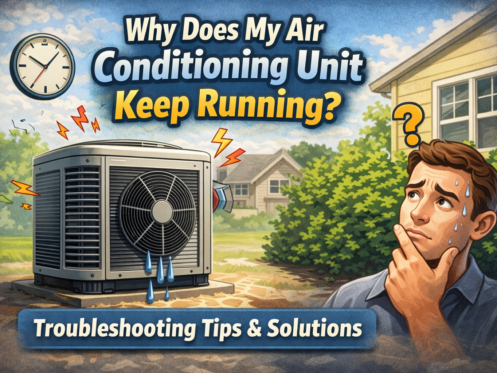
Your air conditioning unit keeps running because it’s struggling to reach or maintain the temperature set on your thermostat. The most common causes are: extreme outdoor heat, a clogged air filter restricting airflow, thermostat problems (wrong settings or a faulty sensor), low refrigerant levels, poor home insulation, an undersized AC unit, leaky ductwork, or frozen evaporator coils. Most of these issues either reduce cooling efficiency or prevent the system from satisfying the thermostat call, leaving the compressor running nonstop.
How an Air Conditioner Should Normally Cycle
Before we get into the problems, it helps to understand what “normal” looks like.
A properly sized, well-maintained air conditioner should cycle on and off throughout the day, typically running for 15 to 20 minutes per cycle, then shutting off once the thermostat set point is reached. On a mild day (say, 75–80°F outside), your system might run two or three cycles per hour, then rest.
On extremely hot days, think 95°F and above, and longer run times are expected. The system may run for 30 to 40 minutes or more before cycling off. That’s not a problem. That’s physics.
The problem occurs when the unit runs all day withoutshutting off, or when it runs constantly but your home never actually cools down. That’s where the following causes come in.
10 Reasons Your Air Conditioner Keeps Running
1. Extremely Hot Weather
Let’s start with the most obvious one, because it gets overlooked more than you’d think.
When outdoor temperatures spike above 95°F, your AC is working against a massive heat load. The system must remove all that heat from your home before it can satisfy the thermostat, and on the hottest days of summer, it may barely keep up.
Symptoms: The AC runs constantly but keeps the house at or near the set temperature.
Fix: Not much to do here except be patient. Keep blinds and curtains closed on sun-facing windows, avoid using the oven, and minimize heat-generating appliances during peak heat hours (2–6 PM).
When to call a tech: If the system runs nonstop in extreme heat but still can’t get your home below 80°F, that suggests an underlying problem; don’t just blame the weather.
2. Dirty Air Filter
This is the single most common cause of an AC running constantly, and the easiest to fix yourself.
Your air filter traps dust, pet dander, pollen, and debris before air enters the system. When it gets clogged, airflow through the system is severely restricted. Less air flowing over the evaporator coil means less heat gets removed from your home per cycle, so the system has to keep running to compensate.
Symptoms: Weak airflow from vents, higher energy bills, and rooms that take forever to cool.
Fix: Check your filter right now. If it’s grey and visibly clogged, replace it. Standard 1-inch filters should be replaced every 30–60 days. Thicker 4–5-inch media filters typically last 6–12 months.
When to call a tech: If changing the filter doesn’t improve airflow within a cycle or two, the restricted airflow may have already caused a frozen coil. see Reason #5 below.
3. Thermostat Problems
Your thermostat is the brain of your HVAC system. When it malfunctions or when it’s simply set up wrong, the system gets confused and keeps running.
Common thermostat issues include:
- Fan set to ON instead of AUTO (covered separately below — this alone causes constant airflow)
- Thermostat location: If the thermostat is near a heat source (sunny window, lamp, kitchen), it reads a higher temperature than the rest of the house and calls for cooling that never stops.
- Miscalibration: An uncalibrated thermostat may think the house is warmer than it actually is.
- Faulty sensor: The temperature sensor inside the thermostat can wear out, causing inaccurate readings.
Symptoms: The house feels cool, but the AC keeps running. Or the thermostat display doesn’t match the actual room temperature.
Fix: Check your thermostat settings, make sure the fan is set to AUTO. Consider relocating it away from heat sources. Replace the batteries. If you have a smart thermostat, check for firmware updates.
When to call a tech: If the thermostat is more than 10 years old or consistently reads inaccurately, it’s time for a replacement. A new programmable or smart thermostat is a relatively inexpensive fix that pays dividends in energy savings.
4. Low Refrigerant Levels
Refrigerant is the lifeblood of your air conditioning system. It’s the substance that actually absorbs heat from inside your home and releases it outside. When the refrigerant is low — usually due to a leak somewhere in the refrigerant lines- the system loses its ability to transfer heat efficiently.
Think of it like trying to pump water with a half-empty tank. The compressor keeps working, but it can’t do the job.
Symptoms: The house won’t cool below a certain temperature, ice or frost on the refrigerant lines or evaporator coil, hissing or bubbling sounds near the condenser unit, and higher energy bills.
Fix: There is no DIY fix for refrigerant. Handling refrigerants requires EPA Section 608 certification. This is strictly a job for a licensed HVAC technician.
When to call a tech: Immediately. Running a system with low refrigerant damages the compressor, one of the most expensive components to replace. A tech will locate and repair the leak, then recharge the system to the correct level.
5. Frozen Evaporator Coil
Inside your air handler, there’s an evaporator coil, a set of copper tubes through which cold refrigerant flows. When airflow over the coil is restricted (dirty filter, blocked vents, low refrigerant), or the refrigerant charge is off, the coil can drop below freezing and ice up.
When the coil is encased in ice, it can’t absorb heat effectively. The system keeps running, but it’s not actually cooling your home. Over time, the ice can grow and completely block airflow.
Symptoms: Little to no airflow from vents, warm air blowing from vents despite the system running, visible ice on the indoor unit or refrigerant lines, water pooling around the air handler when the ice melts.
Fix: Turn the system off (or switch to fan-only mode) and let the coil thaw completely, typically 2 to 24 hours. Check and replace a dirty air filter. Make sure all supply and return vents are open and unobstructed.
When to call a tech: If the coil refreezes after thawing, you likely have a refrigerant leak or airflow issue that requires professional diagnosis.
6. Poor Home Insulation
Your air conditioner doesn’t just fight outdoor heat through your walls; it fights heat infiltration through every gap, crack, and poorly insulated surface in the building envelope. If your home is poorly insulated, conditioned air escapes and hot air pours in constantly, forcing the AC to run without stopping.
Symptoms: Rooms that are difficult to cool, high energy bills year-round, and hot spots near exterior walls or the attic.
Fix: Check attic insulation levels. The Department of Energy recommends R-38 to R-60 in most U.S. climates for attics. Weatherstrip doors and windows. Seal gaps around electrical outlets, plumbing penetrations, and recessed lights.
When to call a tech (or energy auditor): Consider a professional home energy audit. They use blower door tests and thermal imaging to pinpoint exactly where your home is losing conditioned air.
7. Leaky Ductwork
Your duct system is supposed to deliver all of that cooled air from the air handler to each room in your home. But the U.S. Department of Energy estimates that the average home loses 20–30% of conditioned air through duct leaks, gaps at joints, connections, and seams throughout the duct system.
When that cooled air escapes into unconditioned spaces like the attic or crawlspace before it ever reaches your rooms, the AC has to work twice as hard.
Symptoms: Uneven cooling between rooms, excessive dust near vents, rooms that never cool down despite the system running constantly, and higher energy bills.
Fix: Check accessible ductwork for disconnected sections. Seal duct joints with mastic sealant (not standard duct tape, which fails over time). In finished spaces, this requires professional duct sealing.
When to call a tech: If duct leaks are in the attic, crawlspace, or inside walls, a professional will use duct blaster testing and aeroseal or mastic to properly seal the system.
8. Undersized AC System
An air conditioner that’s too small for your home will run constantly, simply because it doesn’t have enough capacity to meet the cooling demand. This is surprisingly common, especially in homes where the AC was replaced without a proper load calculation.
Symptoms: The system runs all day, but the house never quite reaches the set temperature, even on mild days. The problem is worse during heat waves.
Fix: Unfortunately, there’s no DIY fix. If the system is properly maintained and still can’t keep up with a moderate heat load, it’s likely undersized.
When to call a tech: Have an HVAC technician perform a Manual J load calculation to determine the correct system size for your home’s square footage, insulation levels, window area, and local climate. If the current unit is undersized, replacement with properly sized equipment is the long-term solution.
9. Fan Set to ON Instead of AUTO
This one is simple but frequently overlooked. On most thermostats, you have two fan settings:
- AUTO: The blower fan runs only when the compressor is actively cooling. The system cycles on and off normally.
- ON: The blower fan runs continuously, 24/7, regardless of whether the compressor is cooling.
If your fan is set to ON, you’ll notice air constantly blowing from your vents, but much of the time, that air won’t feel particularly cold because the compressor isn’t running. Homeowners sometimes interpret this as the AC running constantly when it’s actually just the fan.
Symptoms: Air always blowing from vents, but not always cold. Higher energy bills from continuous fan operation.
Fix: Switch your thermostat fan setting from ON to AUTO. Done.
When to call a tech: Never. Unless you’d like to have a smart thermostat installed with better fan scheduling options.
10. Aging HVAC System
Air conditioners are mechanical systems, and they wear out over time. As a system ages, especially one that’s approaching or past 15 years old, components lose efficiency. The compressor works harder. Refrigerant charge drifts. Coils get fouled with years of buildup. The result is a system that runs longer and longer to achieve the same cooling that used to take half the time.
Symptoms: Rising energy bills despite consistent usage habits, the system runs noticeably longer than it used to, frequent repair calls, and reduced comfort compared to prior years.
Fix: Regular maintenance can extend the life of an aging system, but there’s an inevitable endpoint. A 20-year-old system operating at 8–10 SEER is far less efficient than a modern unit at 16–20+ SEER.
When to call a tech: If your system is over 15 years old and repair costs are mounting, it’s time for an honest conversation about replacement vs. continued repair. A rule of thumb: if the repair cost exceeds 50% of a new system’s cost, replacement is the smarter investment.
Troubleshooting Checklist: Before You Call a Technician
Run through these steps first. You may solve the problem in five minutes.
- Check your air filter. If it’s visibly dirty, replace it immediately.
- Check your thermostat fan setting. Make sure it’s set to AUTO, not ON.
- Check your thermostat temperature setting. Is it set to a realistic temperature given outdoor conditions?
- Walk around your home and check all vents. Make sure supply and return vents are fully open and not blocked by furniture.
- Look at the indoor unit (air handler). Is there ice on the coil or refrigerant lines?
- Check your outdoor condenser unit. Is it clear of debris, grass clippings, and overgrown shrubs? There should be at least 2 feet of clearance on all sides.
- Check your circuit breaker. Make sure the AC circuit hasn’t tripped.
- Look at your thermostat location. Is it in direct sunlight or near a heat source like a lamp or oven?
- Check the last time the system was serviced. If it’s been more than a year, that’s likely overdue.
If you’ve worked through this list and the problem persists, it’s time to call a licensed HVAC technician.
Is It Bad If My AC Runs All Day?
If your system runs all day and your home never reaches the set temperature, especially on a mild day, something is wrong. This is when constant running becomes a problem.
An AC that runs constantly consumes significantly more electricity than one that cycles normally. If your electricity bills have spiked without a change in behavior or rate, constant runtime is often the culprit.
The compressor is the most critical and expensive component in your system, often costing $1,200–$2,500 or more to replace. Compressors are designed to cycle on and off. Continuous operation without adequate refrigerant, airflow, or proper electrical supply accelerates wear and can lead to premature compressor failure.
Don’t ignore constant runtime. Even if your home is staying cool, investigate the cause; your energy bills and your compressor’s lifespan depend on it.
How to Prevent Your AC From Running Constantly
Most causes of constant AC operation are preventable with routine maintenance. Here’s what every homeowner should be doing:
Replace air filters regularly. This is the single easiest, highest-impact maintenance task you can do. Set a calendar reminder. Every 30 days for 1-inch filters, every 6 months for thicker media filters.
Schedule annual HVAC tune-ups. A professional tune-up each spring (before cooling season) includes cleaning the evaporator and condenser coils, checking refrigerant levels, testing electrical components, lubricating moving parts, and checking thermostat calibration. This keeps the system running at peak efficiency.
Seal your ductwork. Have a technician check for duct leaks. Properly sealed ductwork can dramatically reduce the load on your system and improve comfort throughout the home.
Improve home insulation. Attic insulation is particularly impactful. Adding insulation and air sealing in the attic is one of the highest-ROI home improvements for reducing cooling costs.
Keep the condenser unit clean and clear. Rinse the condenser coil with a garden hose at the start of each season. Remove leaves, grass clippings, and debris. Trim back landscaping.
Calibrate and upgrade your thermostat. An uncalibrated thermostat can cause your system to run longer than necessary. Smart thermostats with learning capabilities and scheduling can optimize runtime and reduce energy waste.
Close blinds and curtains during peak sun hours. Solar heat gain through windows is a significant load in most homes. Simple window treatments can reduce the cooling demand noticeably.
Get a proper load calculation before replacing equipment. If you’re replacing an AC, insist on a Manual J load calculation to ensure the new system is sized correctly. An oversized system short-cycles; an undersized one never stops running.
Frequently Asked Questions
Should my AC run constantly in hot weather?
On very hot days, generally above 95°F, extended run times are normal. Your system may run for 30–40 minutes or longer between cycles. However, it should still cycle off periodically once the thermostat is satisfied. If it never cycles off on a hot day and your home isn’t reaching the set temperature, have the system inspected.
How long should an AC cycle last?
A properly sized, well-functioning air conditioner typically runs for 15 to 20 minutes per cooling cycle, cycling 2–3 times per hour on a moderate day. On very hot days, cycles can extend to 30–40 minutes. If cycles are much shorter (short-cycling) or the system never shuts off, there’s a problem worth investigating.
Can a dirty filter cause the AC to run nonstop?
Absolutely, and it’s one of the most common reasons. A clogged filter restricts airflow through the system, reducing how much heat the evaporator coil can absorb per cycle. The system has to run much longer to satisfy the thermostat. In severe cases, restricted airflow causes the coil to freeze, which makes cooling nearly impossible. Replacing a dirty filter is the first thing to check.
Why does my AC run but not cool the house?
Several issues can cause this: a frozen evaporator coil (blocking airflow), low refrigerant (reducing heat transfer capacity), a dirty condenser coil (preventing heat rejection outside), or a failing compressor. If your system is running but blowing warm or only slightly cool air, turn it off and call a technician; continuing to run a system in this condition can damage the compressor.
Can low refrigerant cause constant running?
Yes. Low refrigerant reduces the system’s ability to absorb and transfer heat, so the compressor runs continuously trying to achieve a cooling effect it can’t produce efficiently. You may also notice ice on the refrigerant lines or coil, hissing sounds, or rooms that simply won’t cool below a certain temperature.
Low refrigerant always indicates a leak; the system doesn’t “consume” refrigerant in normal operation. Only a certified technician can diagnose and repair refrigerant leaks.
Should I turn my thermostat lower to cool faster?
No! and this is a very common misconception. Your air conditioner is not like a car accelerator. Setting the thermostat to 65°F when you want 72°F doesn’t make it cool faster. The system runs at the same rate regardless of how far below the current temperature the set point is.
All you accomplish is making the system run longer (past your desired temperature) and wasting energy. Set it to your actual desired temperature and let the system do its job.
Experts Advice
A constantly running air conditioner is your system’s way of telling you something isn’t right or that it’s simply working hard during extreme heat. The key is knowing the difference.
Start with the basics: check your air filter, verify your thermostat settings, and make sure vents are clear. These simple steps resolve the problem more often than you’d think.
If those checks don’t help, especially if your home isn’t reaching the set temperature, you’re seeing ice on the unit, or your energy bills have climbed unexpectedly, it’s time to call a licensed HVAC technician. Issues like low refrigerant, duct leaks, frozen coils, and aging equipment require professional diagnosis and repair. Catching these problems early protects your compressor, keeps your energy bills in check, and extends the life of your system.
The best investment you can make is a professional tune-up every spring. A well-maintained system runs efficiently, cycles normally, and lasts years longer than a neglected one. If your AC has been running more than usual this season, don’t wait. Schedule a service call and get ahead of the problem before it becomes a costly breakdown.