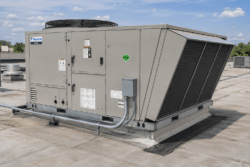
A commercial rooftop HVAC unit, often called an RTU, or rooftop unit, is a self-contained heating, cooling, and ventilation system installed on a building’s roof. It works by drawing in outside air, conditioning it through a refrigeration cycle and heat exchanger, and distributing the conditioned air through ductwork into the building below, while expelling stale air and heat outside. Because all the major components live in one cabinet on the roof, a single RTU can heat, cool, and ventilate an entire commercial space without taking up any usable indoor square footage.
We will explain exactly how that process works, what’s inside the unit, and why rooftop systems have become the standard choice for retail stores, restaurants, offices, schools, and warehouses across the country.
Call For More Information
What Is a Commercial Rooftop HVAC Unit?
A rooftop unit (RTU) is a packaged HVAC system, meaning the compressor, condenser, evaporator coil, blower, and (in most cases) a heating element are all housed in one weatherproof cabinet, rather than split between indoor and outdoor components like a residential split system.
RTUs are sized for commercial loads, typically ranging from 3 tons to over 100 tons of cooling capacity, and are connected to the building through roof curbs and a network of supply and return ductwork.
You’ll find RTUs on the roofs of:
- Retail stores and strip malls
- Restaurants and grocery stores
- Office buildings and warehouses
- Schools, churches, and medical clinics
- Light industrial and manufacturing facilities
How Commercial Rooftop HVAC Units Work, Step by Step
A rooftop unit works by cycling air through four core processes: intake, conditioning, distribution, and exhaust.
Air Intake
The unit pulls in two air streams:
- Return air from inside the building (already conditioned air being recirculated)
- Outside (fresh) air through a dedicated intake, often controlled by an economizer damper
These streams mix inside the unit at a ratio set by the building’s ventilation requirements, typically following ASHRAE Standard 62.1 for commercial indoor air quality.
Conditioning the Air
This is where the unit actually heats or cools the air, using two systems built into the same cabinet:
Cooling (the refrigeration cycle):
- A compressor pressurizes refrigerant gas, raising its temperature.
- The hot, high-pressure gas flows to the condenser coil, where outside air blows across it and removes heat, turning the refrigerant into a liquid.
- The liquid refrigerant passes through an expansion valve, dropping its pressure and temperature sharply.
- The cold refrigerant enters the evaporator coil, where the building’s return/outside air blows across it. The refrigerant absorbs heat from that air, cooling it, and evaporates back into a gas.
- The cycle repeats continuously, with the now-cooled air pushed onward to the blower.
Heating: Most RTUs handle heating in one of two ways:
- A gas furnace section built into the unit (a heat exchanger fired by natural gas)
- Electric resistance heating strips
- Or, in heat pump RTUs, the refrigeration cycle runs in reverse to pull heat from outside air
Air Distribution
A blower/fan assembly pushes the newly conditioned air through the supply ductwork, down through the roof curb, and into the building’s diffusers and vents. Variable-speed or multi-stage blowers adjust airflow based on the building’s demand at any given moment.
Exhaust and Return
Stale indoor air is pulled back into the unit through return ductwork, where it’s either recirculated (mixed with fresh air) or expelled outside through an exhaust damper, completing the loop.
Key Components Inside a Rooftop HVAC Unit
| Component | Function |
| Compressor | Pressurizes the refrigerant to drive the cooling cycle |
| Condenser coil | Releases heat from refrigerant to outside air |
| Evaporator coil | Absorbs heat from building air, producing cool air |
| Blower/fan | Circulates conditioned air through ductwork |
| Economizer | Brings in free outside air for cooling when conditions allow |
| Heat exchanger/furnace section | Provides heating via gas or electric resistance |
| Control board/thermostat interface | Manages staging, temperature setpoints, and scheduling |
| Roof curb | Seals and supports the unit’s connection to the building’s ductwork |
Why Businesses Use Rooftop HVAC Units
Space efficiency
Because the entire system sits on the roof, there’s no equipment room, no indoor condenser pad, and no lost retail or office floor space.
Easier maintenance access
Technicians service the unit from the roof rather than navigating through occupied indoor spaces, which reduces disruption to employees and customers.
Lower installation cost per ton
Packaged units are typically less expensive to install than equivalent split systems for large commercial footprints, since one unit can condition tens of thousands of square feet.
Noise control
Compressors and fans operate above the occupied space rather than next to it, which keeps sound levels down indoors.
Simplified zoning
Many commercial buildings use multiple RTUs, each serving a separate zone, which allows different areas of a building to be heated or cooled independently.
How Long Do Commercial Rooftop Units Last?
Most commercial rooftop units last 15 to 20 years with regular maintenance, though heavy-use environments like restaurants or 24-hour facilities may see a shorter lifespan due to added strain on the compressor and blower motor. Routine filter changes, coil cleaning, and twice-yearly professional inspections are the biggest factors in reaching the high end of that range.
Common Signs a Rooftop HVAC Unit Needs Service
- Uneven heating or cooling across the building
- Rising utility bills with no change in usage
- Unusual noises (grinding, rattling, or clicking) from the rooftop unit
- Weak or inconsistent airflow from vents
- Frequent short-cycling (turning on and off rapidly)
- Visible ice buildup on the evaporator coil or refrigerant lines
Catching these signs early typically means a repair instead of a full replacement.
Call For More Information
What is the difference between a rooftop unit and a split system?
A rooftop unit (RTU) is a packaged system with all components, compressor, coils, blower, and heat source, in a single rooftop cabinet. A split system separates these components between an outdoor condenser and an indoor air handler. Commercial buildings favor RTUs because one packaged unit can efficiently condition large, open floor plans.
How much does a commercial rooftop HVAC unit cost to install?
Installation costs for commercial rooftop units typically range from $8,000 to $30,000+, depending on tonnage, building size, ductwork modifications, and crane requirements for rooftop placement. Larger buildings often require multiple units, which increases total project cost but improves zoning flexibility.
Can a rooftop HVAC unit both heat and cool a building?
Yes. Most commercial rooftop units include both a cooling system (the refrigeration cycle) and a heating source, either a gas furnace section, electric heat strips, or a heat pump function, allowing one unit to handle year-round climate control.
How often should a commercial rooftop unit be serviced?
Commercial rooftop units should be professionally inspected at least twice a year, once before the cooling season and once before the heating season, with filter changes every 1 to 3 months depending on building usage and air quality.
What size rooftop unit does a commercial building need?
Rooftop unit sizing depends on square footage, ceiling height, insulation, occupancy, and equipment heat loads, and is calculated using a Manual N or ASHRAE-based load calculation rather than a simple square-footage estimate. An undersized or oversized unit leads to higher energy costs and shorter equipment life.
Need a Rooftop HVAC Inspection or Replacement?
If your building’s rooftop unit is showing signs of wear, struggling to keep up, or simply due for its seasonal inspection, our certified technicians can evaluate your system and recommend the right next step.