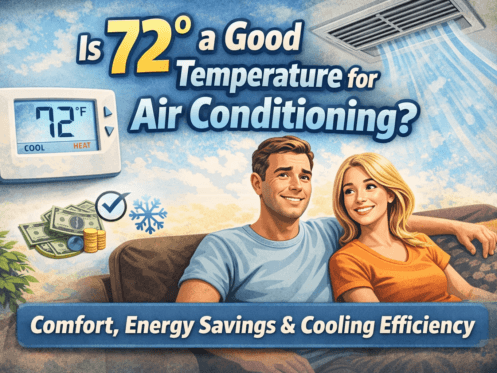
72°F is generally considered a comfortable indoor temperature for most homes. However, whether it’s the ideal setting depends on your local climate, humidity levels, home insulation, HVAC system efficiency, and personal comfort preferences. Many HVAC professionals recommend 72–76°F as a practical comfort range during summer months.
What Temperature Should You Set Your Air Conditioner To?
There’s no single “correct” thermostat setting, but here are the ranges most HVAC professionals and energy efficiency organizations recommend:
Daytime (when you’re home):
- 72°F–76°F is the sweet spot for most households
- The U.S. Department of Energy suggests 78°F when you’re home to maximize cooling efficiency — though many people find this too warm
Sleeping:
- 65°F–68°F tends to promote better sleep for most adults
- The body naturally drops in core temperature during sleep, so a cooler room supports that process
When nobody is home:
- Set it to 85°F or use a programmable setback to reduce unnecessary runtime
- Every degree you raise the thermostat when the house is empty saves roughly 1–3% on cooling costs
A smart or programmable thermostat makes managing these settings automatic — one of the best HVAC upgrades you can make.
Why 72°F Is a Common AC Setting
Ask 10 homeowners what they set their thermostat to in summer, and at least half will say somewhere between 70°F and 74°F. There are good reasons 72°F has become such a popular default:
Comfort balance. 72°F hits a middle ground between “too warm” and “so cold you need a sweater indoors.” For most people, it feels neutral, not noticeable in a distracting way.
Humidity control. Air conditioning doesn’t just cool your home; it removes moisture. At 72°F, most systems run long enough to effectively dehumidify the air, which prevents that clammy, muggy feeling even on humid days.
Cooling efficiency. Running your system at 72°F rather than, say, 65°F reduces the temperature differential between inside and outside. The smaller the gap, the less work your HVAC system has to do, and the lower your energy usage.
Familiar recommendation. Many HVAC technicians, including myself, have historically suggested 70–74°F as a comfort benchmark during service calls. Over time, 72°F has stuck as the cultural default.
Factors That Affect the Ideal AC Temperature
The “right” temperature isn’t just about what feels comfortable in the moment. Several variables influence how well your system maintains that setting, and at what cost.
Outdoor temperature. On a 95°F day, maintaining 72°F indoors puts significantly more strain on your system than on a mild 80°F afternoon. The greater the gap between indoor and outdoor temperatures, the harder your AC works.
Humidity levels. High humidity makes 72°F feel warmer than it actually is. In humid climates, you may need to drop the setpoint to feel comfortable, or invest in a whole-home dehumidifier to address moisture independently of temperature.
Insulation quality. A well-insulated home holds its target temperature with far less effort. Poor insulation means your AC cycles more frequently and struggles to maintain consistent indoor temperatures.
Home size and layout. Larger homes with multiple zones have more flexibility. In a single-zone system, rooms far from the thermostat often end up warmer or cooler than the set temperature.
HVAC system efficiency. Older systems rated at 10–12 SEER work much harder (and cost more) to maintain 72°F compared to a modern 18–20 SEER unit. System age and maintenance history matter.
Number of occupants. People generate body heat. A house with four adults and two kids produces significantly more internal heat load than a home with one person.
Sunlight exposure. South- and west-facing rooms absorb substantially more solar heat in the afternoon. Homes with large windows or minimal shade often require lower thermostat settings to compensate.
72°F vs. 68°F vs. 75°F — Which Is Better?
Here’s a straightforward comparison to help you weigh your options:
| Setting | Comfort Level | Energy Usage | System Workload |
| 68°F | Very cool; great for sleep | High significant increase | Heavy; long run cycles |
| 72°F | Comfortable for most | Moderate — good balance | Moderate; reasonable runtime |
| 75°F | Warm; efficient for most | Low — noticeable savings | Light; shorter cycles |
The bottom line: Each degree you lower your thermostat increases energy consumption by approximately 3–5%. Going from 75°F to 68°F could add 20–35% to your cooling costs over a billing cycle. For most households, 72–74°F is the practical balance between comfort and cost.
What Temperature Do HVAC Experts Recommend?
In my professional experience, and consistent with guidance from organizations such as the American Society of Heating, Refrigerating and Air-Conditioning Engineers (ASHRAE), the recommended indoor comfort range for summer is 73°F–79°F at 50% relative humidity.
The U.S. Department of Energy’s Energy Saver program suggests 78°F when you’re home as the most energy-efficient comfortable setting. That’s warmer than most people prefer, but pairing it with ceiling fans can make it feel 4°F cooler without additional energy cost.
For most of my customers, I recommend:
- 72°F–74°F if comfort is the priority
- 76°F–78°F if energy savings are the priority
- 65°F–68°F only for sleeping, and only in bedrooms via a zoned system or window unit.
How Your Thermostat Setting Affects Energy Bills
This is where homeowners often get surprised. The relationship between thermostat setting and energy cost is direct and measurable.
- Setting your AC to 72°F instead of 78°F can increase cooling energy usage by 15–25%
- Running at 68°F can cost 30–40% more than running at 76°F on a hot day
- Over a full cooling season, that difference can add up to $50–$200+, depending on your climate, home size, and utility rates
The physics are simple: the closer your indoor temperature is to the outdoor temperature, the less work your HVAC system performs. Every degree of setback when you’re away or asleep translates directly to measurable savings.
Smart thermostats, like the Ecobee or Nest, can automate these adjustments and typically pay for themselves within one to two cooling seasons.
Tips to Stay Comfortable Without Overworking Your AC
You don’t have to sacrifice comfort to reduce energy usage. Here’s what I recommend to homeowners every day:
Use ceiling fans. A ceiling fan set to run counterclockwise in summer creates a wind-chill effect that makes a room feel 4°F cooler. This lets you raise your thermostat setting without noticing the difference.
Seal air leaks. Check door frames, window seals, and attic hatches for drafts. A well-sealed home retains conditioned air dramatically better, reducing how often your system has to cycle on.
Schedule regular HVAC maintenance. A system with a dirty coil or low refrigerant charge can lose 20–30% of its cooling efficiency. Annual tune-ups keep your system running at rated capacity.
Replace air filters regularly. A clogged filter restricts airflow, forcing your blower motor to work harder and reducing system efficiency. Replace filters every 1–3 months, depending on your household.
Improve insulation. If your attic insulation is below R-38, upgrading it is one of the highest-ROI home improvements you can make for cooling costs.
Use window coverings. Closing blinds and curtains on south- and west-facing windows during peak afternoon hours can reduce solar heat gain by up to 45%.
Frequently Asked Questions
Is 72°F too cold for air conditioning?
Not for most people. 72°F is within the normal comfort range. However, if you’re running your AC to maintain 72°F in a very humid climate, you may feel chilly due to the dehumidification effect. Try 73–74°F and see if it’s equally comfortable.
What temperature should the AC be set at in summer?
Most HVAC professionals recommend 72–76°F for daytime comfort. The Department of Energy suggests 78°F for maximum efficiency. The right answer depends on your personal comfort threshold and energy budget.
Is 72°F expensive for AC?
It’s moderate. You’ll use noticeably more energy than at 76–78°F, but less than at 68–70°F. In most U.S. climates, 72°F represents a reasonable comfort-cost balance.
What temperature saves the most energy?
The highest setting at which you’re still comfortable. For many homeowners, that’s 76–78°F with ceiling fans running. When you’re away, setting the thermostat to 85°F (or using a programmable schedule) delivers the biggest energy savings.
Is 72°F too cold to sleep?
For most adults, yes — slightly. Sleep research suggests 65–68°F is optimal for quality sleep. If you’re sleeping at 72°F and feel rested, there’s no problem, but cooler nights often result in deeper, more restorative sleep.
Should I use a different setting at night?
Yes. Many homeowners benefit from a slightly cooler setting at night (68–70°F) and a slightly warmer setting during the day when sunlight and activity levels are higher. A programmable or smart thermostat handles this automatically.
Does humidity affect whether 72°F feels comfortable?
Absolutely. At 72°F and 30% humidity, you’ll feel cool and comfortable. At 72°F and 70% humidity, you may feel warm and sticky. Proper humidity control, ideally keeping indoor relative humidity between 40–50%, is just as important as temperature.
Expert Conclusion
So, is 72°F a good temperature for air conditioning? In most cases, yes! It’s a reliable comfort setting that works well for the majority of households during the summer months. It balances effective humidity control, system efficiency, and personal comfort without pushing your HVAC system to extremes.
That said, if energy savings are a priority, consider bumping your daytime setting to 74–76°F and supplementing with ceiling fans. If you’re sleeping, try 66–68°F for better rest. And if you’re away from home, don’t leave your AC fighting to maintain 72°F in an empty house; a programmable setback is one of the smartest HVAC decisions you can make.
The best thermostat setting is the one that keeps you comfortable, protects your system from unnecessary wear, and doesn’t produce sticker shock when your utility bill arrives.
For most homeowners, 72°F fits that description well, but don’t be afraid to experiment by one or two degrees to find your personal sweet spot.
Have questions about your HVAC system’s efficiency or thermostat setup? Our qualified HVAC technician can assess your home’s specific needs and recommend settings tailored to your equipment, insulation level, and local climate.