Summers in Springfield can be hot and humid, and having an air conditioner is essential not just for your comfort, but also your health. If your home’s air conditioning is unusable, you need to find a way to remedy that. But installing a new central air system is expensive. Would getting a few portable air conditioners work instead? Here’s a look at how the two types of air conditioning systems compare.
What Is Central Air Conditioning?
Central air conditioning refers specifically to a system in which cool air circulates around your home through ductwork. It has a central unit that draws air in through a series of vents called returns. These are often located on walls near the floor. You can think of that as air returning to the central unit.
The air then travels through a series of ducts. As the air passes through the central part of the system, it passes over cooled coils that draw out moisture while lowering the air’s temperature. The drier, cooler air is then sent back out into the rooms of the house through another series of ducts to supply vents. These are those smaller vents that sit up near or on the ceiling.
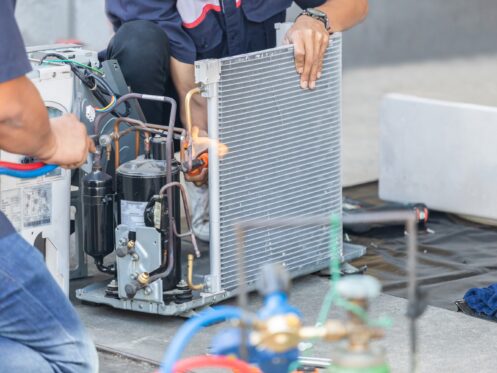
The central unit may be in one or two pieces. The one-piece version is called a packaged system, and the unit is located outside either next to the side of the house, or on top of the roof. Then there are split-system air conditioners in which the components are split between a unit inside the home and a unit outside the home.
Many central systems have one thermostat that determines the target temperature for the entire house. These air conditioners generally do not target one room for cooling. When the cooled air is sent back out, it’s sent to all rooms. Others have multiple thermostats, each controlling the temperature for specific zones in the house. In systems with multiple zones, dampers in the ductwork open and close as needed to shuttle cool air to a specific zone.
What Is a Portable Air Conditioner?
A portable air conditioner is a relatively small cabinet (usually on wheels) with a compact cooling system inside. Each unit has one or two hoses attached that are vented outside through a window. In units with one hose, warm air is drawn in through vents in the unit and cooled inside. The cool air is pushed back out into the room through another set of vents, while the warm air is vented out through the hose.
In dual-hose models, one hose draws warm air in from outside. After the air is cooled, it’s once again pushed into the room through vents while the residual heat is sent out through the other hose.
Portable air conditioners have reservoirs to catch water that condenses as the air cools. Most models require that you manually drain the reservoir, which means shutting off the air conditioner every so often. Some models are self-evaporating; these use the collected water as part of the cooling process and don’t need manual draining.
Which One Is More Energy-Efficient?
If you’re trying to cool an entire house (or at least a large area), a central air conditioner is going to be more energy-efficient. Portable air conditioners definitely work, but they have a lower average Seasonal Energy Efficiency Ratio 2 (SEER2) than central units. That means that they use more power to cool a smaller space.
Another issue is that the portable units have to be vented out through an open window or sliding door. While these units come with window seals to help prevent air leakage, these seals don’t always fit that well. That leads to cool air leaking out and hot air leaking in.
As a result, the portable unit has to work harder to keep the room cool. That raises your energy usage and bills. Multiply that by however many rooms need cooling, and your bills could end up being quite high. Leaving exterior doors and windows open can make a central unit run less efficiently, too, but it’s relatively easy to block those drafts.
Central units do a much better job of distributing cool air to many rooms. These can be expensive to run if you’re in a region with extremely hot temperatures or if you have an older, less-efficient unit. But newer central air conditioner units are still much more energy-efficient than portable units by leaps and bounds.
How Do Costs Compare?
Many people go by initial price when choosing what system to get. But if you compare the two systems and make your choice based on the initial costs to acquire and install the systems, you’re not looking at the whole story.
Installing central air conditioning can cost much more upfront compared to buying one or two portable units. Portable units usually run in the range of hundreds of dollars; central units run in the range of thousands to over $10,000 to install. And that’s with existing ductwork.
But again, if you’re trying to cool an entire house, you have to look at repair and operation costs, too. A central air conditioner will usually last a good three times longer than a portable unit with average care. With excellent care, the central unit will still last longer. You’d have to spend those hundreds of dollars to replace the portable unit multiple times during the lifespan of one central unit.
Given that the operating costs are lower for a central unit, the lifetime costs can be lower overall for central air conditioning. And that’s comparing one portable unit to the central AC. If you’re buying three or four portable units, the difference in operating costs is even more apparent.
Is There Ever a Time When a Portable Unit Is the Better Choice?
If you need to cool a smaller space that’s enclosed, then a portable unit could be totally acceptable. For example, if you have working central air in the house, but it doesn’t extend to the new office/shed you’ve set up in the yard and wired to the home’s electrical system, then a portable unit would be a suitable choice.
Or, maybe you live in a house with roommates who prefer to keep the thermostat for the central air conditioning at a temperature that’s too high for your comfort. In that case, getting a small portable unit sized to your room may work very well.
And, of course, if there’s a prolonged heat emergency and your central air is out, a portable unit can be a temporary solution. It may be less efficient, but it can keep you from developing heat illness.
What About the Lifespan of the Units?
With average care, portable units last anywhere from five to 10 years. Central units can last at least 15 years with average care; they often last up to 20. If you take very good care of the systems, portables can last a few years more, maybe to 15 years. But central units have been known to keep going for 30 years with top-notch maintenance.
How Do Maintenance and Repairs Compare?
Something you need to know about portable air conditioners is that not every air conditioning repair service will work on them. That means it can be much harder to repair them should they break. And the cost of the repair, depending on what needs to be done, could exceed the cost to buy a new portable unit with newer technology.
Central air conditioning repair is a standard service for most repair companies. However, minor issues with the system can quickly become major problems if you ignore them. You have to change the filters regularly and have the system inspected routinely. It’s helpful to schedule a yearly inspection and maintenance appointment each spring before warm weather begins.
Before you choose what type of air conditioner you want to buy, speak with the staff at our AC services company to find out more about how the systems work. If you’re in need of air conditioning repair or new AC installation in Springfield, MO, contact Queen City Heating & Cooling today!